
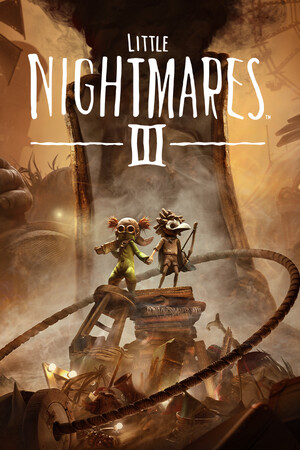
Little Nightmares III
Two new children, Low and Alone, must work together to navigate and escape the massive, twisted reality of The Nowhere in a 2.5D atmospheric puzzle-platformer.
Horror Elements at a Glance
Full Review
Little Nightmares III arrives with a strange kind of pressure. The first two games carved out a very specific identity: oppressive atmosphere, grotesque enemies, simple mechanics, and a sense of helplessness that made every room feel like a trap. LN II raised the stakes so dramatically that the franchise felt poised for a new era of horror. But LN III comes from a new studio (Supermassive Games) and that shift is felt immediately. This isn’t just another chapter in the same nightmare. It’s a reinterpretation, a pivot, and in many ways, a line in the sand for what Little Nightmares might become.
A New Studio, A New Nightmare
I went into LN III blind, and I didn’t even know Supermassive had taken over. I expected and was hoping for more of the same kind of escalation LN II delivered: more dread, more grotesque imagery, more atmospheric terror. Instead, the difference was obvious from the opening minutes. The animation style, the scale, the tone, even the pacing felt different. Not worse by default, but undeniably different.
LN III feels less like a continuation and more like a reboot wearing the skin of the original. It captures the spirit of Little Nightmares (the 2.5D traversal, the monstrous residents, the environmental storytelling) but it doesn’t feel like the same world Tarsier built. It’s grander, brighter, more animated, and more action‑driven. And while that isn’t inherently bad, it does mean LN III sits at an odd crossroads: familiar enough to belong, but different enough to potentially divide fans.
A Second Child You Can't Sit Next To
The biggest shift is the co‑op design. Low and Alone, each with their own tools (a bow and wrench) are meant to work together. In theory, this opens the door to clever puzzles and shared tension. In practice, the execution is baffling.
LN III supports online co‑op only; no couch co‑op. No sitting side‑by‑side, experiencing the nightmare together. For a franchise built on atmosphere and shared dread, this omission is hard to understand. It’s not just a missed opportunity, it’s a fundamental contradiction of what co‑op horror is supposed to feel like.
Playing solo, the AI companion works well enough. It doesn’t break puzzles or behave erratically. But it also doesn’t add anything meaningful. It feels tacked on, like a requirement of the co‑op premise rather than a natural evolution of the series. The dual‑character design doesn’t enhance tension or deepen the horror. It simply exists, and the game sort of just bends around it.
Combat is more present than ever, pushing LN III toward action‑adventure territory. It’s not bad per se, but it’s definitely a tonal shift. While LN I and II used violence sparingly, making every hit feel heavy, LN III uses it often enough that it changes the rhythm of the game. It still feels like Little Nightmares, but it doesn’t feel like Little Nightmares.
A World Bigger Than Ever
If LN III excels anywhere, it’s in its environments. The Necropolis, Candy Factory, Carnevale, and Institute are expansive, detailed, and visually ambitious. The scale is larger than anything in the first two games, and the environmental storytelling (frozen bodies, ruined structures, unsettling machinery) is strong throughout.
Monster Baby’s introduction in the Necropolis is one of the game’s best moments. Its massive silhouette stumbling through the background evokes the Stay Puft Marshmallow Man in the most sinister way possible. The stone‑frozen victims scattered through the ruins add a chilling sense of inevitability. In the end, you don’t defeat Monster Baby, you only survive it.
The Candy Factory is jarring in the best way. Bright pink sludge and candy colors clash violently with the grotesque machinery and the Supervisor’s spider‑like movements. The Carnevale is the standout chapter, a grimy funfair filled with ventriloquist dummies that deliver the game’s creepiest chase sequences and most shocking gore. The Institute leans into abandoned‑hospital dread, with bandaged figures patrolling sterile corridors.
But the visual style, rounded, plush, and animated, consistently softens the horror. The environments are sinister, but their almost cartoonish rendering keeps them from being truly terrifying. LN III’s world is impressive, but it lacks the oppressive visual weight that defined LN I and II.
The Residents of the Spiral
LN III introduces a wide roster of enemies, each tied to its chapter. Monster Baby is the strongest conceptually, atmospherically, and mechanically. The Supervisor is creepy and well‑designed, especially in her spider form, but again the art style blunts her impact. The Carnevale’s Herd is grotesque, and the ventriloquist dummies deliver the game’s most disturbing moments. The Institute’s masked figures are interesting but lack the sinister presence of LN II’s mannequins.
The variety is impressive, but it comes at a cost. None of LN III’s enemies reach the iconic status of the Teacher or Thin Man. They’re memorable in the moment, but they don’t linger. Deaths are mixed, some earned, some cheap, and the tension never reaches the heights of the earlier games.
What the Spiral Sounds Like
The sound design is one of LN III’s strongest elements. Crawling creatures, buzzing insects, and cinematic chase music all land well. The game finally introduces random ambient noises; subtle, out‑of‑nowhere sounds that make you pause and wonder what’s watching you. This was something I specifically found missing from LN I and II, and it’s a welcome addition.
But the audio doesn’t create iconic horror moments. It supports the atmosphere, but it doesn’t elevate it. The visuals and sound work well together, but they don’t reach the unforgettable synergy of LN II’s hospital or LN I’s library.
What Stays With You
Looking back, LN III definitely has memorable scenes: Monster Baby’s reveal, the Supervisor’s spider chase, the Carnevale’s gore. Unfortunately, nothing really stays with you the way the best moments of the first two games did. The game is creepy, well‑designed, and ambitious, but it never truly scares. The visual style keeps the horror at arm’s length, and the co‑op mechanics dilute the sense of isolation that defined the franchise.
LN III is a worthy game, but it’s a different game. It stands in the spirit of Little Nightmares, but not in its shadow. If you loved LN I and II for their oppressive dread and grotesque atmosphere, you may be disappointed. If you enjoy atmospheric 2.5D platformers like Inside, Limbo, or Cocoon, LN III is absolutely worth playing.
It’s a good game. A fun game. A creative game. But it’s also a pivot, and a line in the sand for what Little Nightmares might become. Whether the series returns to its roots or continues down this new path remains to be seen. Either way, LN III is worth experiencing for what it is: a new nightmare, told in a new voice, still echoing the old one.
Atmosphere Sound Design
The sound design is one of LN III's strongest elements—crawling creatures, buzzing insects, and cinematic chase music all land well, and the new ambient noise is something I specifically missed from the first two games.
Controls Accessibility
The controls themselves stay simple and accessible—it's the co-op design layered on top that causes problems, not moving or interacting with the world.
Difficulty Challenge Design
The general difficulty stays fair and forgiving, though the doll puzzles lean too hard on vague trial-and-error.
Enemy Monster Design
Monster Baby is the strongest of the new enemies, conceptually and atmospherically, but none of LN III's cast reaches the iconic status of the Teacher or Thin Man—they're memorable in the moment, but they don't linger.
Fear Factor Tension
The game is creepy and well-designed, but it never truly scares—the visual style keeps the horror at arm's length in a way the first two games never did.
Game Pacing Length
The levels run excessively long and padded, turning what should be a tight, digestible experience into something closer to an exhausting slog.
Gameplay Mechanics
Combat is more present than ever, pushing LN III toward action-adventure territory, and the online-only co-op design with a companion that doesn't add much makes the whole system feel tacked on rather than a natural evolution.
Replayability
Between the online-only co-op and a solo AI companion that doesn't add much, there's not a lot pulling me back for a second run.
Story Narrative
The environmental storytelling, frozen bodies, ruined structures, unsettling machinery, is strong, but the story itself functions more as a thematic spinoff than a real continuation of what LN II set up.
Visual Design Art Direction
The visual style, rounded, plush, and animated, consistently softens the horror—the environments are sinister on paper, but their almost cartoonish rendering keeps them from ever feeling truly terrifying.
Official Trailer
About the Reviewer

A lifelong horror fan with a particular obsession with supernatural horror and sci-fi. Josh approaches every review from the perspective of a genuine enthusiast, not a critic, instead asking the questions that actually matter: does it scare you, does it linger, and is it worth your time?